
We’ve been fascinated by Vrel since first coming across his work a decade ago. So we’ve been looking forward for quite a while to the first ever exhibition devoted to him: Vrel, Forerunner of Vermeer at the Mauritshuis in The Hague.

The puzzle of the scene is given added tension by the tilted chair. But apart from the subject matter, the details are fascinating. It’s actually an interior window in a house; and what a terrific window it is, made up of tiny panes of glass that reflect the light at the top right. Several are cracked. The limited decor is so precisely depicted — the light on the brass platter, the curtain hooks and the curtains themselves, one loosely drawn back, the other in tight folds. Almost unnoticed at the top right of the picture is a nail, which casts a shadow on the wall, and on the floor is an apparently discarded scrap of paper; Vrel put his signature on it, a device he used on several occasions.
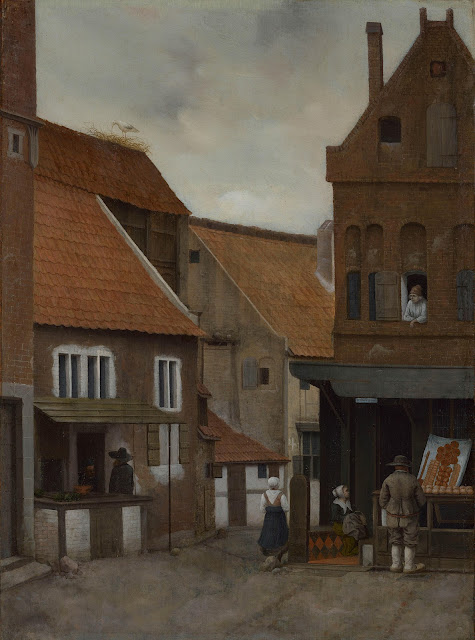
Vrel made another version of the same scene, which is also on display in the exhibition; it includes some spot-the-difference variations, such as the stork’s nest being replaced by a chimney. That picture was acquired by the Hamburger Kunsthalle in 1888 as a Vermeer; Vrel’s signature (which varies widely through his works) had been changed into IVMEER.
Vrel began painting “little streets” in about 1635-40, making them among the earliest such representations in Dutch art, two decades before Vermeer created his own Little Street. The one below was bought in Germany by Théophile Thoré, the 19th-century French art critic who is regarded as having rediscovered Vermeer. It was attributed to the Dutch architecture painter, Gerrit Berckheyde, having previously been sold as a Vermeer.

Thoré discovered the signature IVREL on the stone bench to the left of the standing figures, and it was this incidental finding that brought Vrel back to the attention of the art world, after two centuries of obscurity.
These exterior paintings helped kindle interest in Vrel, but they don’t have the fascination of the interiors, which make up the majority of the 13 pictures in this show. Because nothing is more essence of Vrel than this…. that very distinctive window with the ghostly face of a child peering in, a seated woman alone, absorbed in some activity, in an almost empty room and, there on the red tiled floor, the scrap of paper with his signature.

There’s always a sense that the artist knows something we don’t. In Vrel’s only dated painting, from 1654. a man’s cloak and hat are hanging on the left. He must be in the house, so he’s not the person outside talking to the woman at the window whom we see only from the back, as so often in Vrel. And despite all the straight lines, angles and the grid of the windowpanes, his scenes are not harsh or cold.

Only about 50 works by Vrel are known, but there could be others misattributed or just hanging somewhere undiscovered. If you’re having a look in the attic, you’ll need to know that he signed his paintings in many different ways — just a few of them below.

Practicalities
The museum is located next to the Binnenhof, the seat of the Dutch government and parliament, and is just 10 minutes’ walk from Den Haag Centraal station. 9292.nl is an excellent site to find out public-transport connections across the Netherlands.
The exhibition is due to move on to the Fondation Custodia in Paris, opening there on June 17, though it’s not yet mentioned on the institution’s website.
While you’re in the Mauritshuis….
If you were compiling a Top 20 of Dutch Golden Age paintings, the Mauritshuis has at least five contenders: Start your tour in room 9 on the second floor with Rembrandt’s mould-breaking group portrait, The Anatomy Lesson of Dr Nicolaes Tulp. In room 12, The Bull by Paulus Potter steals the show, a triumph of naturalism: flies, cowpats and all. Round to room 14 for The Goldfinch, one of the few known works by Carel Fabritius. Two of the five, Vermeer’s View of Delft and Girl with a Pearl Earring, are, though, currently to be seen in the exhibition in the Rijksmuseum, but the girl with the pearl is back in The Hague on April 1.
Elsewhere in The Hague….
There’s a lot to enjoy. The most prominent exponent of the Hague School of painting, Hendrik Mesdag, is celebrated most memorably in the Panorama Mesdag, his 360-degree view of the city’s beach resort of Scheveningen made in 1881. Just minutes from the Mauritshuis, you can plunge into the mind of that witty and fascinating graphic artist MC Escher at Escher in the Palace. There’s also currently an Escher exhibition on at the Kunstmuseum, a couple of kilometres out of the city centre towards Scheveningen, which has a vast collection that spans Delftware, fashion and art from the late 19th century on, including hundreds of works by Piet Mondriaan.
Images
Jacobus Vrel, A Seated Woman Looking at a Child through a Window, after 1656, Fondation Custodia, Frits Lugt Collection, Paris
Jacobus Vrel, A Seated Woman Looking at a Child through a Window, after 1656, Fondation Custodia, Frits Lugt Collection, Paris
Jacobus Vrel, Street Scene with a Bakery by the Town Wall, presumably the Waterstraat in Zwolle, after 1646, Private collection
Jacobus Vrel, Street Scene with a Woman Seated on a Bench, after 1650, Rijksmuseum, Amsterdam
Jacobus Vrel, Woman Leaning out of an Open Window, 1654, Kunsthistorisches Museum, Gemäldegalerie, Vienna
Montage of Vrel signatures, courtesy Mauritshuis