


Samuel-Jean Pozzi was a Parisian gynaecologist, with links to avant-garde art circles. You might expect a late 19th-century professional to be portrayed in a dark suit, but Sargent shows Dr Pozzi in a crimson dressing gown, wearing Turkish slippers. Standing in front of red curtain, it’s as if he’s on the stage. Sargent is then perhaps not so much the artist as the stage manager of this dramatic scene. This painting, done when Sargent was in his mid-20s, was his first to be shown at the Royal Academy in London. His friend Vernon Lee, we learn, said it had “an insolent kind of magnificence, more or less kicking other people’s pictures into bits”.

Madame X is Virginie Gautreau, like Sargent an American in Paris and seemingly cut from the same mould. Gautreau was admired in Parisian social circles for her appearance, which, we’re told, she enhanced with exaggerated white make-up and striking gowns. You might think that dress is pretty daring for 1884, but it’s not as daring as Sargent’s original version of the painting, which showed a strap slipping off her right shoulder. Critics at the Paris Salon denounced that as indecent, and Gautreau’s mother lamented the damage to her daughter’s reputation. Madame X herself called it a masterpiece, and Sargent protested he’d painted her “exactly as she was dressed”.
As Oscar Wilde was to write a few years later, “There is only one thing in the world worse than being talked about, and that is not being talked about.”
Sargent loved black. He adored the work of Diego Velázquez and Frans Hals. One of the best of the many anecdotes in this show tells how Sargent, on a visit to Claude Monet, couldn’t do any work because the Impressionist didn’t have any black paint.

The cloak itself is displayed alongside, and the comparison gives you a really good idea of how Sargent manipulated the clothes his sitters wore to great effect. Draped over a mannequin, you catch a glimpse, but really only a glimpse, of the pink lining to the cloak made by the Worth fashion house.
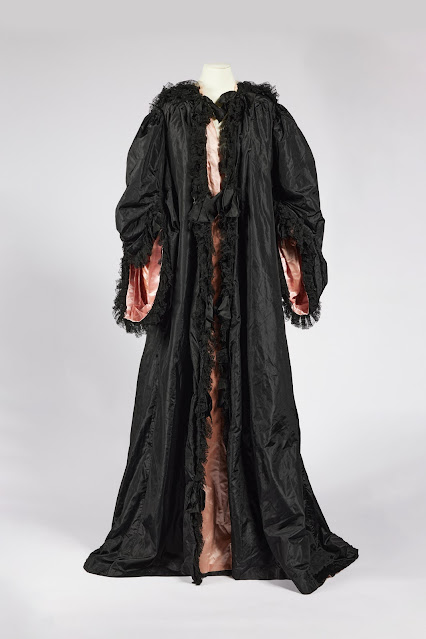
Sargent makes his model wrap the cloak around herself, turning the lining outward to give a dramatic diagonal slash of pink across the canvas. As well as the cloak, there are several more original costumes scattered through the exhibition, but right at the start, this one provides perhaps the best example of how Sargent choreographed his materials.


Sargent moved away from the society portrait later in his career, and the penultimate room contains a series of paintings of the sort he called “intertwingles” — sometimes sketchy compositions depicting textures, fabrics and shapes in landscapes, often painted during his extensive summer travels. There’s experimentation here, and the clothes seem more about decoration than showing off. Lady Fishing — Mrs Ormond, from the late 1880s, is an early example, concentrating on the shape of the white dress and the pattern of ripples on the water.
Practicalities
Sargent and Fashion is on at Tate Britain until July 7 and is open daily from 1000 to 1800. Full-price tickets cost £22 and are available online here. We spent two hours in the exhibition. The nearest London Underground station to Tate Britain is Pimlico on the Victoria Line, about five minutes walk away.
Images
John Singer Sargent (1856-1925), Dr Pozzi at Home, 1881, The Armand Hammer Collection, Hammer Museum, Los Angeles
John Singer Sargent, Madame X, 1883-84, The Metropolitan Museum of Art, New York. Image © The Metropolitan Museum of Art/Art Resource/Scala, Florence
John Singer Sargent, Lady Sassoon, 1907, Private collection. Image © Houghton Hall, Norfolk
Opera cloak worn by Lady Sassoon, c. 1895, Private Collection. Image © Houghton Hall, Norfolk
John Singer Sargent, Portrait of Miss Elsie Palmer (A Lady in White), 1889-90, Colorado Springs Fine Arts Center
John Singer Sargent, Carnation, Lily, Lily, Rose, 1885-86, Tate