
Another in a series about the strange doings at the intersection of art and love.
 |
| Jimmy Swinnerton |
Jimmy Swinnerton’s life was even zanier than the comic strips he created (including Sam and his Laugh, Professor Nix, Little Katy and her Uncle, Mount Ararat, Mr. Batch, Mr. Jack, Little Jimmy, Canyon Kiddies, The Daydreams of Danny Dawes, and Rocky Mason, Government Marshall.)
Born in 1875, Swinnerton ran away from home at age 14 to join a traveling minstrel show. He used blackface makeup as a disguise to elude his parents and the sheriff.
Swinnerton led an adventurous life during the waning days of the wild west. He rambled from job to job (and from bar fight to bar fight). He drank heavily, gambled constantly, spent recklessly, and lied shamelessly. These attributes made him irresistible to women.
Depending on how we count, Swinnerton had somewhere between four and six wives. His biographer claimed that Swinnerton also “had a lady friend hiding behind every sagebrush on the desert,” but let’s confine ourselves to his wives. Here’s the scorecard:
- Swinnerton’s first wife was Thalia Treadwell, a glamorous San Francisco heiress. They married under mysterious circumstances; when friends asked for details, Swinnerton would only say, “the marriage took place between [San Francisco
and New York] but I can’t tell you the place nor date for legal reasons.” The couple quarreled bitterly, and Thalia abandoned her new husband and went to Japan.
- Swinnerton next married Harriet Hacker after a whirlwind courtship. Harriet was beautiful but she “enjoyed the night scene“ a little too much, going out to the clubs and sometimes not returning for days. When Swinnerton
contracted tuberculosis he asked Harriet to move to the desert for his health, but she refused, citing the shortage of nightclubs in the desert.
- Although still legally married to
Harriet, Swinnerton moved to the desert alone. There he quickly found a new girlfriend, Espie Castle. The 1910 US
census reports that Jimmy married Espie (which would’ve made him a bigamist) but in response to questions, he was evasive about their status. When Espie had a religious
conversion and asked Swinnerton to join her in pious living, he quickly left.
- In 1917 Swinnerton belatedly divorced Harriet and two days later married his third – or fourth – wife, Louise Scher, a statuesque blonde divorcee. The two quarreled constantly over Louise’s spending habits on lace nightgowns. Swinnerton borrowed thousands of dollars from her mother to pay for Louise’s extravagances, then left without repaying her.
- By 1933, Swinnerton was living in Las Vegas. He divorced Louise and quickly married his fourth – – or fifth – – wife, Gretchen
Richardson. On her way to the wedding, Gretchen stopped
off at a Vegas casino to play roulette. She placed a
silver dollar on number 12 and when the number hit, she decided it was an omen and stayed to gamble rather than go to her wedding. She eventually showed up several hours late.
 |
| Espie |
 |
| Gretchen |
 |
| Louise |
 |
| The final Mrs. Swinnerton |
Swinnerton was quick to marry and just as quick to leave. He seemed to lack the patience or interest to explore what lay beneath the surface of his wives. Yet, his attitude toward art was the exact opposite.
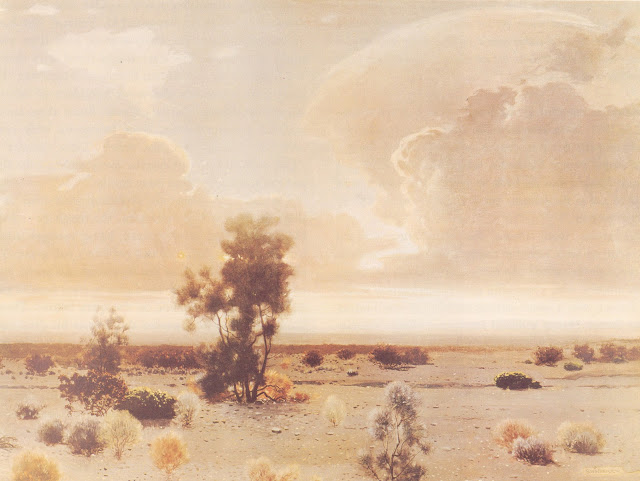
Swinnerton had infinite patience for painting the same desert landscapes over and over for decades. He would loyally return every year to the same sites to paint the same scenes. One of his exasperated wives complained, “why I do this each year I have never been able to figure out, because it’s the same trip, same road, auto camps, same climate, and has been for the last several years.”

 |
| One has to wonder how Swinnerton’s love life would’ve changed if he’d devoted the same level of effort to his wife |
