
After last week’s arguments over politics and war, we are overdue for another report on the curious doings at the intersection of art and love:
 |
| Norman Lindsay and Rose Soady |
Artist Norman Lindsay said that he usually began his complex pictures by drawing a single female form, then built the rest of his composition around that central image. Starting in 1902, the central figure in Lindsay’s life was his favorite model (and later wife) Rose Soady.
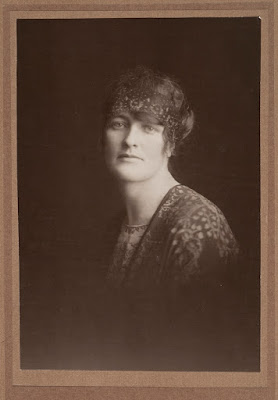
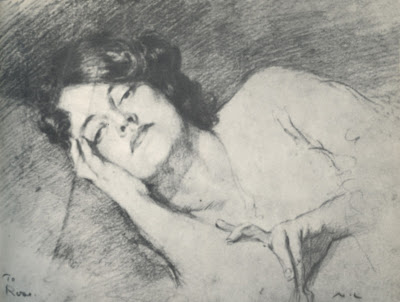 |
| Sketch of Rose, 1905 |
In a dusty used bookstore I recently stumbled across Rose’s memoir of her unconventional life with Norman.
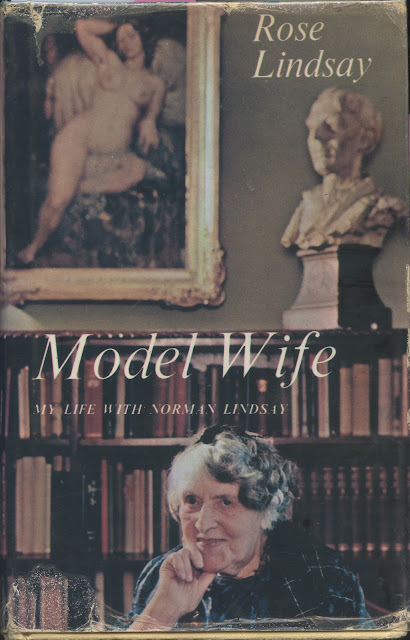
Lindsay was married with children when Rose began modeling for him, but after two years Rose reports the two consummated their relationship “spontaneously and without premeditation,” then stayed together for the rest of their lives. She was apparently the rare woman who was scrappy and open minded enough to keep up with him.

Rose described the extraordinary measures the couple took to hide their scandalous relationship. She lied to her mother about posing nude and Lindsay lied to his wife that he was sleeping in his studio. The couple lied to their landlady that they were brother and sister (but were sternly evicted when the landlady caught on). Later when the couple rented adjoining rooms, they cut a secret trap door in the wall so they could get together.
The partition was only thin wood, which made entry from room to room easy– just by cutting a trap door. A saw and two hinges were all that was necessary for the job. It was cut out just above floor level and the drawing table placed against the trapdoor; a chair, a mat, and a scatter of papers and books made it look just right to callers.
But here’s the interesting part: despite their elaborate efforts to keep up pretenses, Norman’s pictures of Rose seemed to be public advertisements for their affair. Why even bother lying to their landlady if Norman was constantly drawing pictures like this?
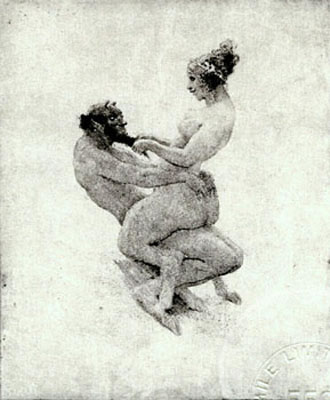
Lindsay became famous for his hundreds of pictures of wild nymphs and satyrs trysting.
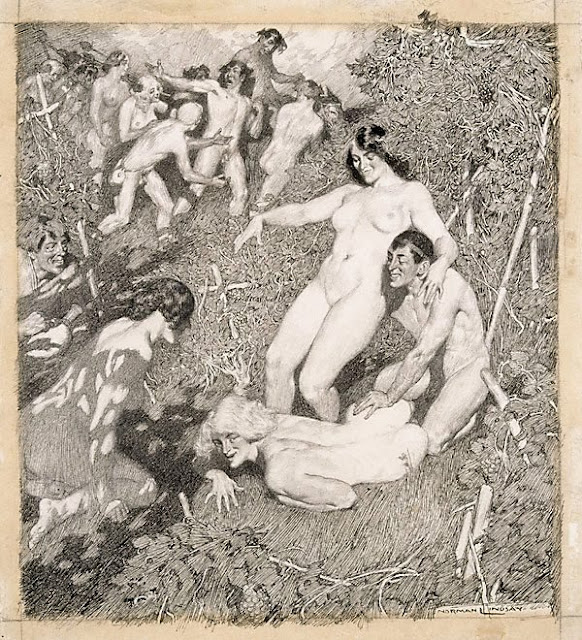
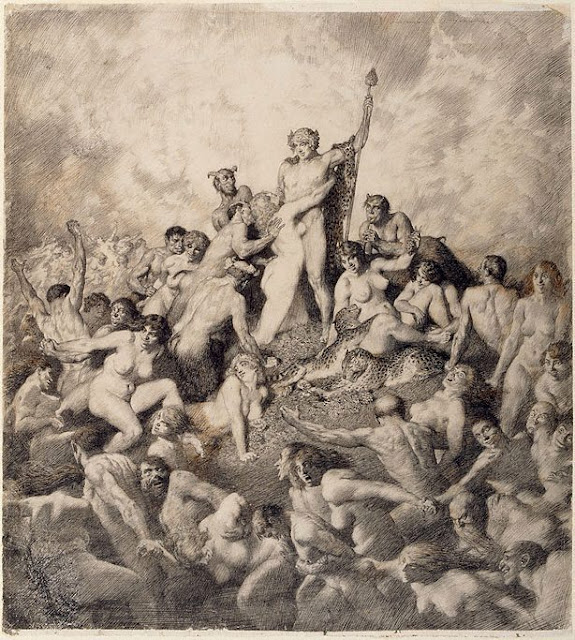
Artists who draw the most intimate or controversial subjects often seem to feel shielded by their art. Art is an act of imagination, and the audience can’t prove where fact ends and fantasy begins, which emboldens artists to put all kinds of subject matter out there. Once a picture is launched, it becomes something separate from the artist, who– if pressed– can disavow any reality in the content.
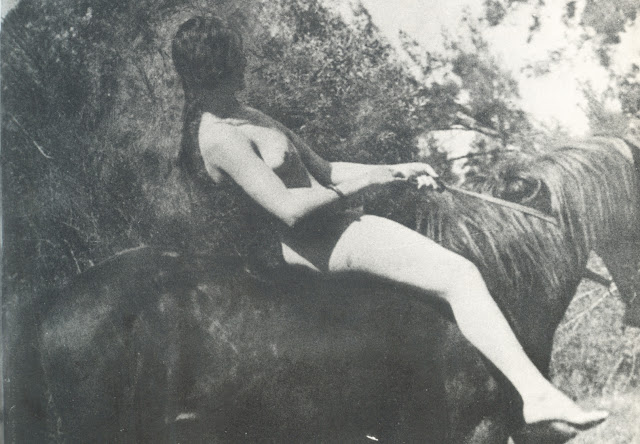
Where did the fact end and the fantasy begin? Above, Norman’s reference photo of Rose (reproduced in her memoir). Below, a fanciful drawing by Norman.
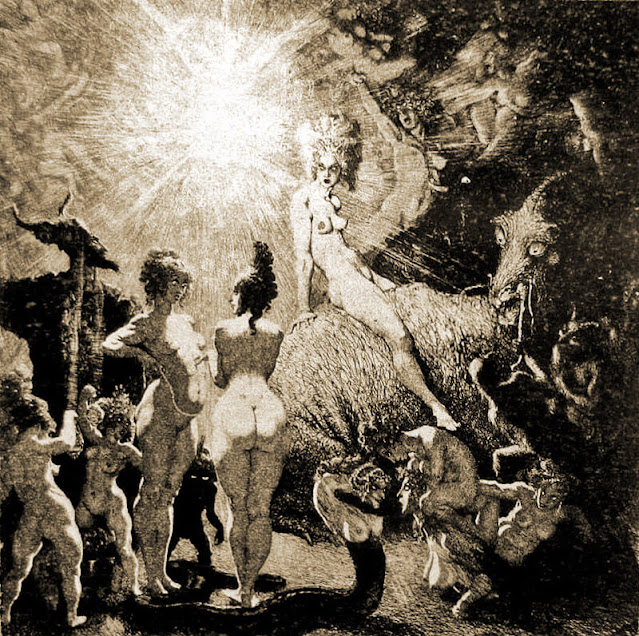
Of course, some friends and family were unwilling to abide by the polite fiction and stopped associating with Norman or Rose. Some art galleries and museums refused to exhibit Norman’s work. Angry clergy scolded the couple. By 1913, when Norman drew Rose in the role of “Venus Crucified” by society’s prudes, the jig was pretty well up:
.jpeg)
Looking back, Rose seemed to relish her youthful adventures. In her memoir she proudly reprinted some of Norman’s [NSFW] early photos of her. “Those were the days,” she recalled.
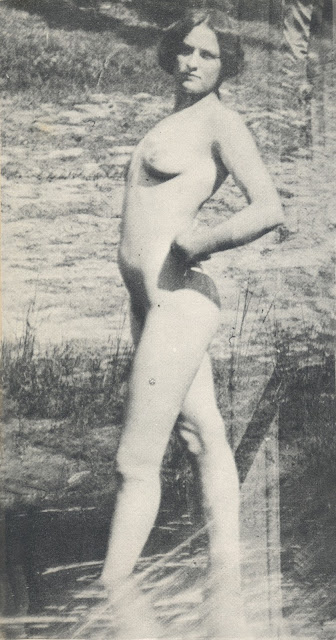
Norman developed their personal photos himself using chemicals in their small kitchen. Rose recalled that the chemicals smelled terrible, but apparently the results were worth it.
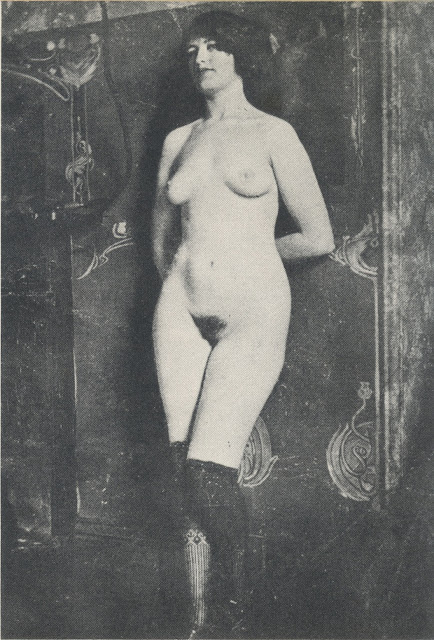
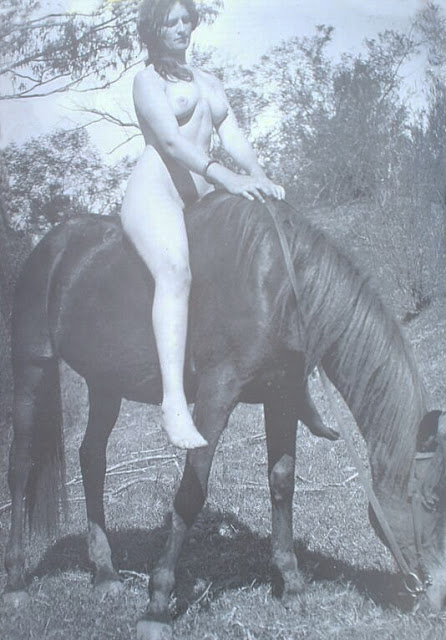
Norman passed away in 1969, and Rose followed him in 1978.