
I love Cy Twombly’s drawing, Orpheus.

Let’s see if you can too.
____________________________________________
In times of uncertainty for painting, artists often revert to their primal roots in drawing to help find their way. As curator Katharine Stout noted, drawing has long been the mechanism for strengthening the gene pool of fine art, contaminating it with strong graphic properties, bold notions from advertising and comics, structural strength from geometric and mathematical systems, and other impertinent strains.
As we’ve previously discussed, the 1950s witnessed a renaissance in expressive drawing using basic tools, such as vine charcoal or a lithography crayon. Artists who had long painted polished, realistic images using oil paint or gouache began returning to the simplest, most primal ways to make marks.
For example, Austin Briggs painted sophisticated oil paintings like this as they slowly went out of fashion…

… before finding new vitality in drawings such as this:

Artists such as Briggs, Eric, Sickles, Fuchs and Bouche led the revival of rough drawing tools. They persuaded the leading high end magazines to devote entire pages of prime space to charcoal drawings.
This 1964 illustration by Bernie Fuchs is a snapshot of what was gained from the reintroduction of line. We can see the old world and the new world co-existing briefly side by side:
 |
Fuchs painted the face of this athlete sensitively enough to achieve an excellent likeness…


Fuchs’ cover is an excellent example of that turning point in the evolution of illustration, with drawing and painting juxtaposed against each other in the same image, like a piano and a symphony orchestra juxtaposed against each other with the invention of the piano concerto. People sat up and took notice of the new style. Everyone wanted more.
Look at a detail from this drawing by Briggs:


Briggs combines the directness, simplicity and immediacy of the crayon with an underlying sensitivity that persuades us he could perform brain surgery wearing mittens.


Why? Because this is part of the physical delight of the drawing, just as impasto is part of the physical delight of painting.
This has been a long prologue to the reasons I love Cy Twombly’s Orpheus but if you’ve accompanied me this far, I hope you’ll be willing to come with me a little further.

Like the great illustrators, fine artists such as Picasso, de Kooning and Twombly spent a lot of time mid-century trying to unlearn stubborn conventions. De Kooning experimented drawing with his eyes closed, trying to understand better the intuitive sources of art. Twombly practiced drawing in the dark, recognizing that such drawings would lose many obvious qualities but interested in what he might gain.

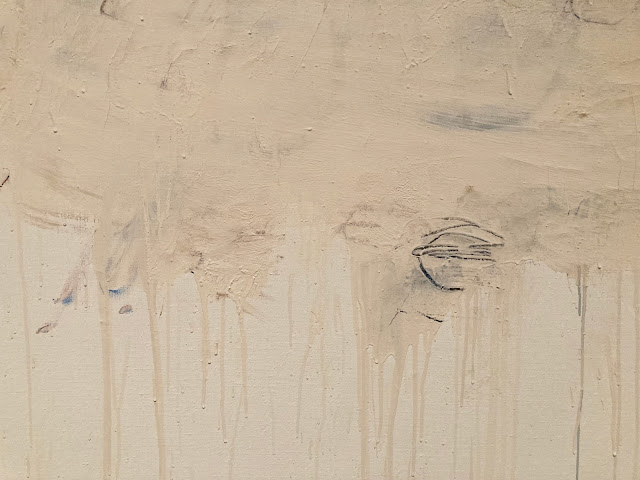
I think this painting can stand alone as a lovely abstract design but if you’re prepared to go beyond form and look for content, it’s there in spades. You won’t be able to read it like a story in The Saturday Evening Post; it must be approached more like a fragment of an ancient, time-worn text.
…a giant O takes up the left part of the canvas. The remaining letters, smudged, and mostly erased, spread to the right and downward, like descending notes on a musical stave. There is a sense of resignation or fade-out in the script’s formation, as if the word were not worth completing, the gods having long since departed. But the letters’ placement also conjures Orpheus himself descending to the underworld to retrieve his beloved Eurydice.

Twombly, a lover of antiquity, was adamant that he wasn’t trying to cast off tradition with his innovations. He said, “what I am trying to establish is that modern art isn’t dislocated, but something with roots, tradition, and continuity.”