
,%201864,%20oil%20on%20strawboard%20mounted%20on%20Gatorfoam,%2047.2%20x%2035.2cm%20%C2%A9%20National%20Portrait%20Gallery%20(wecompress.com).png)
Scent could do many things in Victorian painting; it could imply hedonism – pleasure in exquisite sensations – and a preoccupation with beauty; or reflect the Victorian vogue for synaesthesia (evoking one sense through another); or stir moods and emotions.
.jpg)
You get the chance to experience that olfactory sign in a novel interactive exercise. A scent dispenser is incorporated into a unit near the painting, and all you have to do is press the relevant button to release the distinctive odour of a green pasture after the rain. The girl’s thick shawl, which protects her and the smaller child, provides a second smell, one that we found a bit indistinct.
,%201867%20-%201868,%20watercolour%20and%20gum%20over%20pencil,%20on%20paper,%2045.2%20x%2032.8cm.%20%C2%A9%20Birmingham%20Museums%20Trust.jpg%20(wecompress.com).jpg)
We learn at the start of the show that in 1855, the Victorian physiologist Alexander Bain described vivid multisensory experiences as the normal, healthy response to imagery. A picture of flowers, he argued, “gives an agreeable suggestion of the fragrance,” because it would trigger memories of smelling actual flowers, setting into play the same muscles and nerve tracks. With their gorgeous flowers, censers of incense and vials of scented poison, Victorian Aesthetic paintings seem designed to prompt such an reaction, according to curator Dr Christina Bradshaw.
.jpg)
This next girl, in her long simple white dress, looked to us so childlike and innocent as she dreamily put her nose to the posy in a vase on a shrine. But in the mid-1890s, when it was painted by John William Waterhouse, a critic branded her as “rather sensual and not so pure as she ought to be”. And that stooping to smell roses was “out of keeping with the religious reverence of a shrine”.
.jpg)
There’s no shortage of flowers in Lilium Auratum by John Frederick Lewis. The viewer can’t but sense the intense heady odour of the lilies combined with the more delicate perfume of all the roses. The two Eastern-looking figures, busy selecting their bouquet from a great variety of flowers, are far from the usual depictions of harem women reposing or dancing. Lewis’s canvas recalls Victorian ideas of Eastern sensuality, luxury, wealth and abundance.
.jpg)
.jpg)
Practicalities
Compton is just off the A3 if you’re travelling by car. It’s easy to get to by public transport: Take a train to Guildford, from where the 46 bus runs direct to the gallery once an hour Mondays to Saturdays, taking just over 10 minutes. On a nice day, it’s a pleasant walk from Guildford on an easy route in a little over an hour via the River Wey and then the North Downs Way, which goes right past the Watts Gallery.
Images
GF Watts (1817-1904), Ellen Terry (Choosing), 1864, National Portrait Gallery, London. © National Portrait Gallery
John Everett Millais (1829-1896), The Blind Girl, 1856. Birmingham Museums Trust. Photo by Birmingham Museums Trust, licensed under CC0
Simeon Solomon (1840-1905), A Saint of the Eastern Church (formerly called A Greek Acolyte), 1867-68, Birmingham Museums Trust. Photo by Birmingham Museums Trust, licensed under CC0
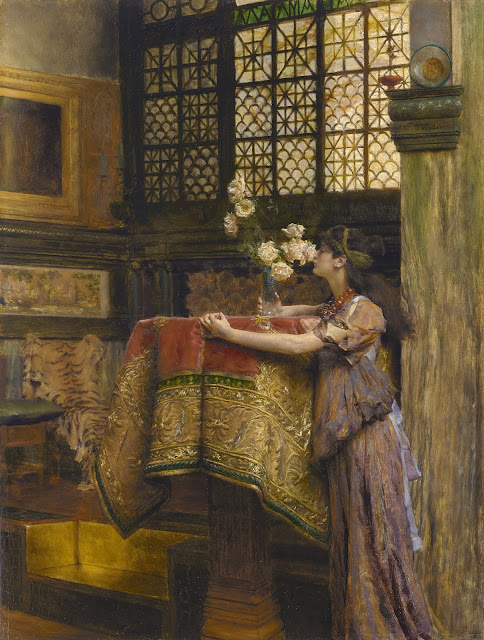
Sir Lawrence Alma-Tadema (1836-1912), In My Studio, 1893, The Royal Borough of Kensington and Chelsea
John William Waterhouse (1849-1917), The Shrine, 1895, Private collection
John Frederick Lewis (1804-1876), Lilium Auratum, 1871, Birmingham Museums Trust. Photo by Birmingham Museums Trust, licensed under CC0
John William Waterhouse, Psyche Opening the Golden Box, 1903, Private collection